



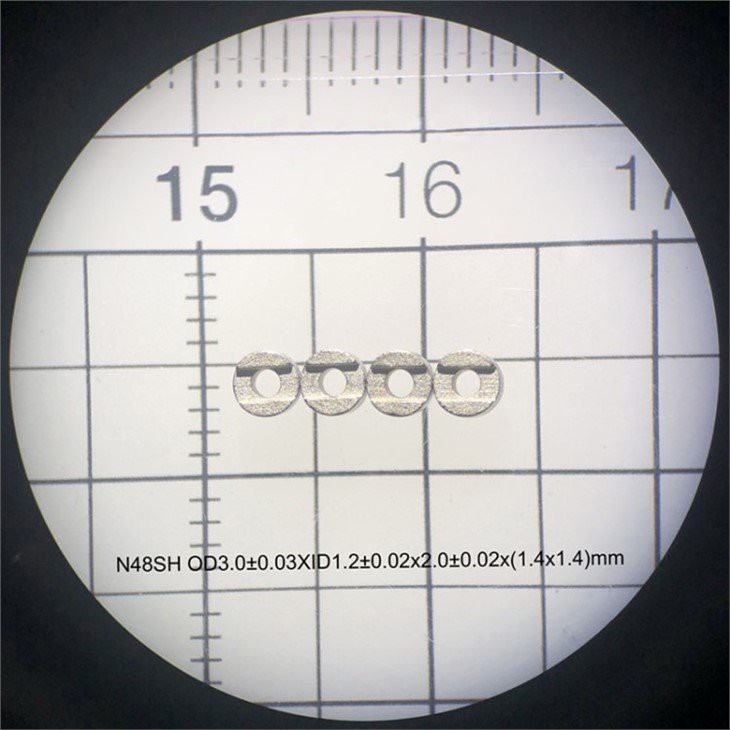

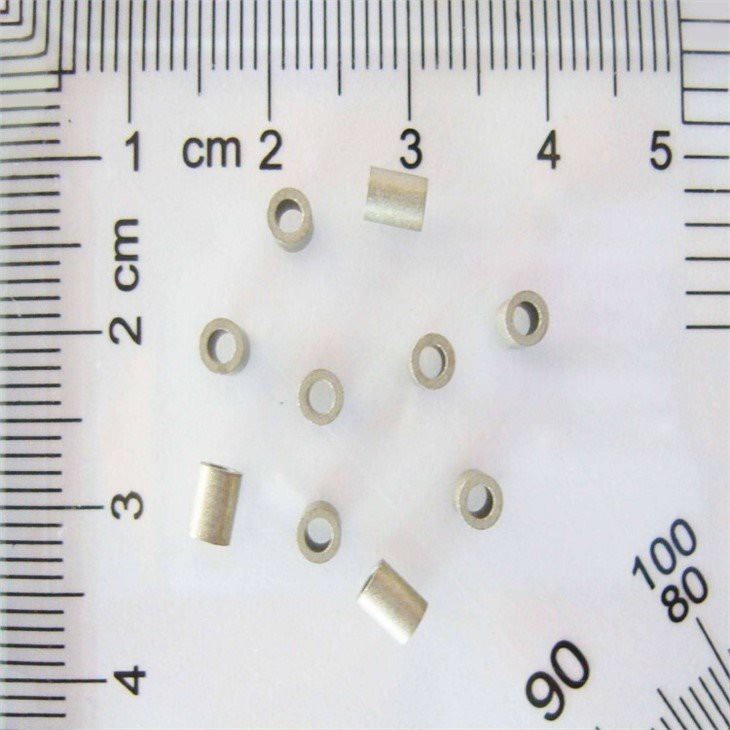
AMR Sensor Magnet
AMR sensor can well realize the weak magnetic field measurement which in the range of geomagnetic field, and then has been widely applied in many areas, includes the navigation compass, the rotational position sensing, yaw rate sensing and trajectory tracker of virtual reality.
Some Introduction of AMR sensor
AMR sensor magnet is a high-precision magnetic component used with anisotropic magnetoresistance (AMR) sensors to detect position, speed, or rotation.
Typically made from neodymium material, these magnets provide stable and uniform magnetic fields, ensuring accurate signal output in sensor systems. They are essential for enabling precise measurement of linear and rotational positions.
AMR sensors are capable of detecting weak magnetic fields within the range of the geomagnetic field, and are widely used in applications such as navigation compasses, rotational position sensing, yaw rate sensing, and trajectory tracking in virtual reality systems. To achieve accurate measurement performance, AMR sensors must be paired with suitable AMR sensor magnets.
What is the Anisotropic Magnetoresistance (AMR) Effect?
The Anisotropic Magnetoresistance (AMR) effect is a phenomenon in which the electrical resistivity of a ferromagnetic material (such as NiFe and NiCo alloys) changes depending on the angle between the direction of the current and the external magnetic field applied to the material.
The AMR effect was discovered in ferromagnetic polycrystals by William Thomson, 1st Baron Kelvin, in 1857. After that, it gradually gained more attention, especially with the development of magnetic disk heads based on the AMR effect in 1971.
The core material of an AMR sensor is an anisotropic magnetic-sensitive material, with permalloy being the most commonly used. When a thin film of permalloy is deposited onto the surface of a silicon chip, it forms a resistor strip. Therefore, its grain size and morphology have a significant impact on the performance of the sensor.

About AMR Sensor Magnets
Both ferrite and rare-earth magnets can be used as AMR sensor magnets. Therefore, AMR sensors should be equipped with suitable magnets to achieve optimal performance.
It should be noted that a relatively high magnetic field is beneficial for reducing the influence of stray magnetic fields on sensor accuracy. The alignment between the geometric center of the AMR sensor and the magnet is also very crucial, as misalignment can cause errors in the entire system.
Meanwhile, the magnetic field strength near the magnet's surface is not sufficiently uniform, so the air gap is determined by multiple factors.
Hongyu has developed a wide range of magnetoresistance sensor magnets and aims to provide reliable and cost-effective solutions.

Magnetization and Pole Design
AMR sensor magnets can be designed with different magnetization patterns, including multi-pole and radial magnetization.
Proper pole design is critical to ensure accurate signal detection and compatibility with sensor systems. Custom pole configurations are available based on application requirements.
fAQ
Hot Tags: amr sensor magnet, China amr sensor magnet manufacturers, suppliers, factory, measurable weighing sensor magnet, Flexible Neodymium Magnet, Magnetic Sensor Magnet, high efficiency tmr sensor magnet, Brake Sensor Magnet, stable operation brake sensor magnet


Send Inquiry
