



Neodymium Collar Magnets
A standard ring magnet doesn't always sit where the assembly needs it. Stepped Neodymium Ring Magnets feature an integrated shoulder that provides a positive axial stop, making them useful for controlled positioning around shafts, locating pins, and recessed mounting points.
What Makes a Stepped Neodymium Ring Magnet Different?
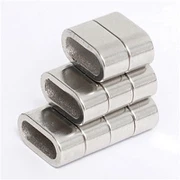
A stepped neodymium ring magnet is a sintered NdFeB ring with two different outer diameters. The smaller cylindrical body fits into a mounting bore, while the wider flange rests against the surrounding surface.
That shoulder is the reason for the design. A conventional ring magnet may need a separate spacer, retaining component, or carefully controlled adhesive depth to establish its axial position. A stepped ring provides a physical seating reference as part of the magnet itself.
The flange does not prevent rotation on its own. Its primary function is to control axial positioning and provide a repeatable seating surface. Where rotational locking is required, the assembly must include a suitable mechanical feature or other retention method.
For precision assemblies, eliminating an extra locating component can be more valuable than increasing the magnet's holding force.


Dimensions, Magnetic Grades and Available Sizes
Stepped neodymium ring magnets are defined by four primary dimensions: body diameter, flange diameter, overall height, and center bore diameter.
The relationship between these dimensions determines how the magnet fits into its housing and how much material remains around the central opening.

N42 provides a practical starting point for many applications. N45 and N50 may be considered where a higher magnetic energy product is required within the same available space.
However, a higher grade does not automatically solve every magnetic performance problem. Bore diameter, flange thickness, air gap, operating temperature, and the surrounding steel components all influence the final magnetic circuit.
The flange thickness should also be specified when its seating position is critical. Two magnets with the same overall height and outer diameters may fit differently if their shoulder depths are not identical.
Applications of Stepped Neodymium Ring Magnets
The stepped profile is particularly useful where magnetic performance and mechanical location must be considered together.
Sensor and Positioning Assemblies
A stepped ring can be installed over a locating pin or shaft, with its flange seated against a reference surface. This helps maintain a consistent axial position relative to a nearby magnetic sensor.
For applications using Hall-effect sensors or magnetic encoders, the magnetization pattern and sensor position must be matched to the intended signal. The shoulder controls the mechanical seating position, while the magnetic field determines what the sensor detects.
Magnetic Couplings
Stepped ring magnets may be incorporated into magnetic coupling assemblies where a central bore and defined axial mounting position are required.
The flange helps establish the installed position of the magnet, but torque transmission depends on the magnetic circuit, pole configuration, and mechanical retention of the rotating components.
A simple axially magnetized ring should not be assumed to provide rotational coupling torque without a suitable magnetic design.
Precision Fixtures and Chucks
In fixtures, a stepped ring can sit inside a counterbore with the flange resting against the machined shoulder. This provides a repeatable mounting depth without relying entirely on adhesive placement.
The central opening can accommodate a locating pin, fastener clearance, or another assembly feature, depending on the design.
Shaft-Mounted Magnetic Components
The through-hole allows the magnet to fit around a shaft or spindle, while the larger outer diameter provides an axial locating feature.
This arrangement is useful when installation space is limited and the magnet must remain at a defined position along the shaft.
For rotating assemblies, suitable retention and balance must be considered separately from the magnetic design.
Precision Grinding, Magnetization and Surface Protection
Stepped neodymium ring magnets are manufactured from pressed and sintered NdFeB blanks. Because sintered neodymium is hard and brittle, the bore, cylindrical body, and flange are finished using precision diamond grinding rather than conventional metal-turning methods.
The relationship between the bore and the two outer diameters is especially important. Excessive runout or an uneven flange can prevent the magnet from seating squarely in its housing.
Typical dimensional tolerances are approximately ±0.1 mm, subject to the magnet's size, geometry, and drawing requirements. Applications requiring tighter concentricity or shoulder-height control should specify those characteristics separately.
Standard magnetization is axial, with the north and south poles on opposite end faces. Alternative magnetization patterns may be evaluated for sensor or coupling applications where the magnetic field must vary with angular position.
Nickel-copper-nickel plating is the standard protective finish. Epoxy coating may be specified where additional resistance to moisture or incidental coolant exposure is needed, although coating selection should be checked against the actual operating environment.
The bore and flange edges require careful handling. Sintered NdFeB can chip under impact or excessive assembly pressure, so these magnets should not be force-fitted into undersized holes.

Custom Stepped Neodymium Ring Magnets
The value of a stepped ring magnet lies in how accurately it matches the surrounding components.
For a quotation, provide the body diameter, flange diameter, overall height, bore diameter, and flange thickness. A sectional drawing is especially helpful when the shoulder depth, concentricity, or mounting clearance is critical.
We can review non-standard dimensions and confirm the appropriate NdFeB grade, magnetization direction, coating, and achievable tolerances before production.
If the magnet will operate on a rotating shaft, near a sensor, or inside a magnetic coupling, include the working temperature, installation arrangement, and required magnetic performance.
A stepped ring should do more than fit the hole. It should locate consistently, remain secure in service, and deliver the magnetic field the assembly was designed around.
FAQ
Hot Tags: neodymium collar magnets, China neodymium collar magnets manufacturers, suppliers, factory, block shape neodymium magnet, high performance parylene coated magnet, horseshoe shape neodymium u channel magnet, Neodymium Cylinder Magnet, Neodymium Sphere Magnet, Neodymium Tile Magnet




Send Inquiry
