



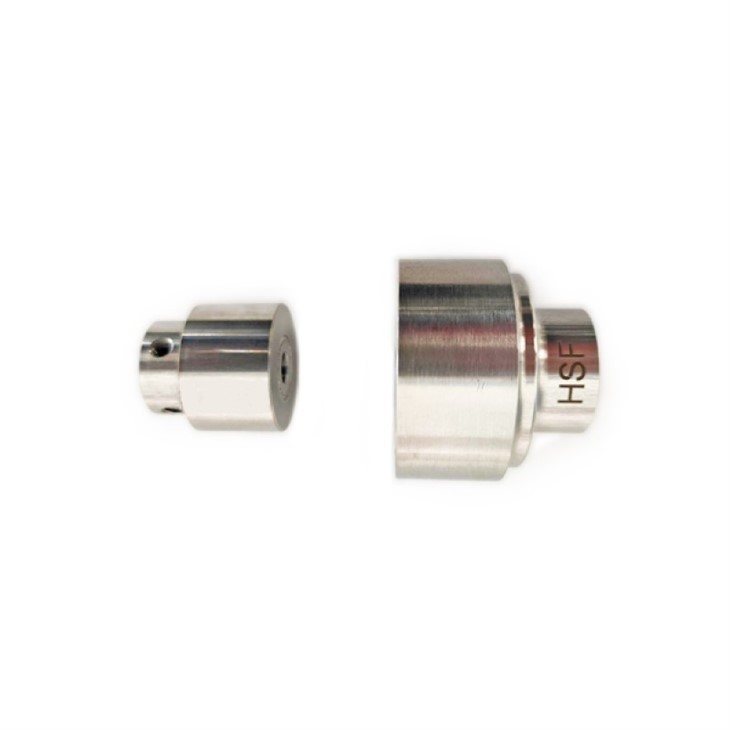


Radial Magnetic Coupling
An major usage of permanent magnets is magnetic coupling, which primarily relies on the attractive force between diametrically opposed magnetic poles to create noise- and friction-free non-contact transmission between internal and exterior mechanical systems.
Radial magnetic coupling
An major usage of permanent magnets is magnetic coupling, which primarily relies on the attractive force between diametrically opposed magnetic poles to create noise- and friction-free non-contact transmission between internal and exterior mechanical systems.

Characteristics:
1. Convert conventional dynamic sealing to static sealing to achieve power transmission with zero leakage.
2. Vibration transmission can be prevented, allowing for the stable operation of machinery with non-contact transmission.
3. Disengage the over-load safety.
4. Easy to construct, troubleshoot, and maintain simple structure.
5. There are various movement types, such as linear movement, rotational movement, and screw compound motion.
6. Get rid of pollution.

Classifications:
There are several classification criteria for magnetic coupling:
1. Based on the coupling concept, can be divided into synchronous, eddy current, and hysteretic types.
2. Based on the type of movement, can be classified as linear type, rotational type, and screw type.
3. Based on the structural form, can be divided into cylinder type and disc type.
4.Depending on how the magnets are arranged, they can be divided into intermittent and combined types.

Structural Parameter Optimization:
There are numerous structural characteristics for magnetic coupling, and changes in these parameters will have an immediate impact on how much torque is transmitted.
1. The magnetic pole number should be optimized. The magnetostatic energy principle states that when pole numbers rise, energy may be stored more efficiently, leading to the release of static energy after it has been transformed into kinetic energy. However, having too many poles results in more flux leakage, which reduces the density of flux across the air gap and the resulting torque. Small effective radius or small air gap requires more poles, while high effective radius or big air gap requires fewer poles.
2. Achieving the ideal yoke iron thickness. Yoke iron may successfully block the magnetic field from the outside. Yoke irons, which are a component of the magnetic circuit system, have the ability to modify the flux density's strength and distribution as well as its leakage and the permanent magnetic field's operational state. Iron with a thin layer will first induce magnetic saturation, followed by an increase in magnetic resistance, and lastly a reduction in torque.
3. Improving the thickness of permanent magnets. The permanent magnet offers the magnetic potential for the entire circuit. The torque increases as the air gap flux density increases. Within certain bounds, the permanent magnet's thickness will cause a significant increase in torque. Due to magnetic resistance and flux leakage, torque stops increasing once thickness reaches a particular point.
Hot Tags: radial magnetic coupling, China radial magnetic coupling manufacturers, suppliers, factory



Send Inquiry
